


Where your next big client comes from
Most specialist firms grow the same way for the first few years. A good client refers another good client. Work arrives through people who already trust you. You get busy, then busier, and you never have to think hard about where the next client will come from.
Then it slows down.
Referrals start coming from the same few people. Deals get smaller, or every deal turns into a price conversation. One client quietly becomes a third of the business. You know you need to grow, but “grow” isn’t a plan. It’s a wish.
Referrals got you here, but they won’t take you somewhere new.
When an owner asks me where they should grow next, I don’t start with a list of companies or a campaign. I start with one question: where is your expertise worth the most, to buyers you can actually count?
There are only four places the answer can be. This post walks through all four, how to tell which one fits your firm, and how to test it in 30 days before you spend real money or hire anyone to chase it.
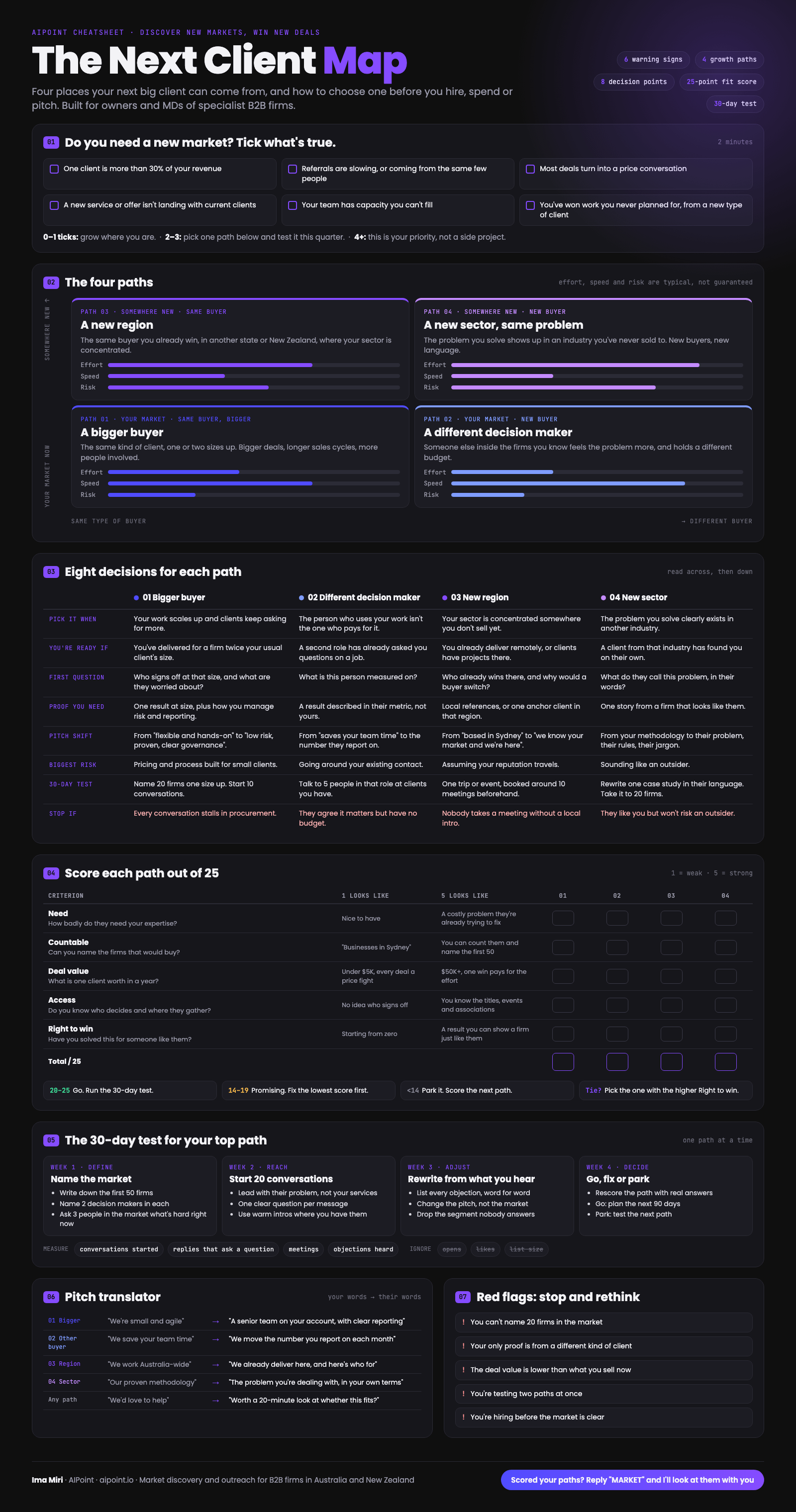
First, do you actually need a new market?
Not every firm does. If your pipeline is healthy and your clients are diverse, the best growth move is usually to do more of what’s working.
Tick the statements that are true for your firm right now:
One client is more than 30% of your revenue. It feels like success until that client restructures, changes procurement or gets bought.
Referrals are slowing, or coming from the same few people. Your network is a fixed size. It runs out.
Most deals turn into a price conversation. When buyers compare you on price, it usually means they can’t see why you’re different. That’s often a market problem, not a pricing problem.
A new service or offer isn’t landing with your current clients. Your existing clients bought you for something else. A new offer often needs a new buyer.
Your team has capacity you can’t fill. Good people sitting idle is the most expensive way to wait for referrals.
You’ve won work you never planned for, from a new type of client. That’s the market telling you something.
0 to 1 ticks: grow where you are. 2 to 3: pick one path below and test it this quarter. 4 or more: this is your priority, not a side project.
The four paths
Every new client you win comes from one of four places. Think of it as a simple map with two questions:
Where: do you stay in the market you know, or go somewhere new?
Who: do you sell to the same type of buyer, or a different one?
Same type of buyerDifferent buyerYour market now1. A bigger buyer2. A different decision makerSomewhere new3. A new region4. A new sector, same problem
Each path has a different level of effort, speed and risk. In general, the paths in your current market are faster and safer. The paths somewhere new take more work, but they’re where the biggest step changes usually come from.
Path 1: A bigger buyer
What it is: the same kind of client you already serve, one or two sizes up. Bigger deals, longer sales cycles, more people involved in the decision.
Pick it when your work scales up and clients keep asking you to do more.
You’re ready if you’ve already delivered for a firm twice the size of your usual client.
The first question to answer: who signs off at that size, and what are they worried about? At a bigger firm, the person who signs is rarely the person who feels the problem. They’re usually worried about risk, reporting and whether you’ll still be there in two years.
The proof you need: one result delivered at size, plus a clear answer on how you manage risk and report progress.
How the pitch changes: from “we’re flexible and hands-on” to “low risk, proven, clear governance”. Small clients buy agility. Big clients buy safety.
The biggest risk: taking pricing and processes built for small clients to a big buyer. Procurement will find every gap.
A 30-day test: name 20 firms one size up from your usual client and start 10 conversations.
Stop if every conversation stalls in procurement. That usually means you need a different entry point or more proof at size first.
Path 2: A different decision maker
What it is: someone else inside the firms you already know feels the problem more, and holds a different budget.
Pick it when the person who uses your work isn’t the person who pays for it.
You’re ready if a second role has already started asking you questions on a job.
The first question to answer: what is this person measured on? If you can’t answer that, you can’t pitch to them.
The proof you need: a result described in their metric, not yours. An operations director cares about downtime. A finance director cares about cost and predictability. Same work, different number.
How the pitch changes: from “we save your team time” to “we move the number you report on each month”.
The biggest risk: going around your existing contact. Bring them with you, don’t go behind them.
A 30-day test: talk to five people in that role at clients you already work with. Ask what’s hard right now, then listen.
Stop if they agree the problem matters but have no budget for it. That’s a signal to go back to Path 1 or look elsewhere.
This is usually the fastest path, because you already have access. It’s also the most overlooked.
Path 3: A new region
What it is: the same buyer you already win, in another state or in New Zealand, where your sector is concentrated.
Pick it when the buyers you serve best are concentrated somewhere you don’t sell yet. Every state has its own mix of industries, projects and capital programs.
You’re ready if you already deliver remotely, or your clients have projects there.
The first question to answer: who already wins work there, and why would a buyer switch to someone new?
The proof you need: local references, or one anchor client in that region. Buyers in a new region want to know you understand their market and you’re not going to disappear.
How the pitch changes: from “based in Sydney” to “we know your market and we’re here”.
The biggest risk: assuming your reputation travels. It doesn’t. In a new region, you start from zero with most buyers.
A 30-day test: one trip or one event, booked around 10 meetings arranged beforehand. Don’t fly in and hope.
Stop if nobody takes a meeting without a local introduction. That tells you to build a partner or referral channel there first.
Path 4: A new sector, same problem
What it is: the problem you solve shows up in an industry you’ve never sold to. New buyers, new language, often new regulations.
Pick it when the problem you solve clearly exists somewhere else.
You’re ready if a client from that industry has already found you on their own. That’s the strongest early signal there is.
The first question to answer: what do they call this problem, in their own words? Most firms fail here because they describe the problem the way their old industry does.
The proof you need: one story from a firm that looks like them. Not your best case study, your most relevant one.
How the pitch changes: from your methodology to their problem, their rules and their jargon.
The biggest risk: sounding like an outsider. Buyers can tell within one sentence.
A 30-day test: rewrite one case study in their language and take it to 20 firms.
Stop if they like you but won’t take the risk on an outsider. You may need a partner, a certification or a smaller first project to get in.
This is the path with the most effort and the most risk. It’s also where I’ve seen the biggest results. One client sold the same specialty to a different kind of buyer, in a sector he’d never sold to, and went from $500 deals to $500K deals. He didn’t change what he did. He changed who he sold it to.
How to choose: score each path out of 25
Once you’ve looked at all four, score each one from 1 to 5 on five questions. Be honest. The point is to compare paths, not to prove the one you already like.
Question1 looks like5 looks likeNeed: how badly do they need your expertise?Nice to haveA costly problem they’re already trying to fixCountable: can you name the firms that would buy?”Businesses in Sydney”You can count them and name the first 50Deal value: what is one client worth in a year?Under $5K, every deal a price fight$50K or more, one win pays for the effortAccess: do you know who decides and where they gather?No idea who signs offYou know the titles, the events and the associationsRight to win: have you solved this for someone like them?Starting from zeroA result you can show a firm just like them
Add up each path:
20 to 25: go. Run the 30-day test.
14 to 19: promising. Fix the lowest score first, then test.
Under 14: park it and score the next path.
A tie? Pick the path with the higher Right to win. Proof shortens every sales cycle.
The usual surprise: most firms score their current market lower than they expect, and a smaller, more specific market higher. A market you can count usually beats a big one you can’t.
That’s also why “Countable” matters so much. If you can’t name the first 50 firms in a market, you don’t have a market yet. You have an idea.
Run a 30-day test before you commit
Don’t commit a year, a salary or a big budget to a path you haven’t tested. Run one path at a time for 30 days.
Week 1: Define. Write down the first 50 firms in the market. Name two decision makers in each. Then ask three people who work in that market what’s hard for them right now. Those three conversations will change your pitch more than any amount of desk research.
Week 2: Reach. Start 20 conversations. Lead with their problem, not your services. Ask one clear question per message. Use warm introductions wherever you have them.
Week 3: Adjust. Write down every objection, word for word. Change the pitch, not the market. If one segment isn’t answering at all, drop it and focus on the ones that are.
Week 4: Decide. Rescore the path with real answers instead of assumptions. If it still scores well, plan the next 90 days. If it doesn’t, park it and test the next path.
What to measure: conversations started, replies that ask a question, meetings and objections heard.
What to ignore: opens, likes and the size of your list. None of them tell you whether a market wants what you sell.
Change the pitch, not just the target
Picking the right market is half the work. The other half is saying the right thing to it. The same expertise needs different words for each path:
PathWhat firms usually sayWhat the buyer needs to hearBigger buyer”We’re small and agile”“A senior team on your account, with clear reporting”Different decision maker”We save your team time”“We move the number you report on each month”New region”We work Australia-wide”“We already deliver here, and here’s who for”New sector”Our proven methodology”“The problem you’re dealing with, in your own terms”Any path”We’d love to help”“Worth a 20-minute look at whether this fits?”
If buyers in a new market ask for a quote and then disappear, look at the pitch before you look at the market. They may have compared you on price because nothing in your message told them why you’re different.
Red flags: stop and rethink
Pause before you go further if any of these are true:
You can’t name 20 firms in the market. You don’t have a market yet.
Your only proof comes from a different kind of client. Get one relevant result first, even a small one.
The deal value is lower than what you sell now. A new market should make the business stronger, not busier.
You’re testing two paths at once. You won’t know which one worked, or why.
You’re hiring before the market is clear. A new BDM with a clear market starts conversations in week one. A BDM with only a territory can spend months working out who to call.
What this looks like in practice
One firm came to us with 145 LinkedIn followers and almost no outreach. The founder had spent years inside the sector he wanted to sell to. He knew it better than most, but its buyers didn’t know him.
We tested one segment in month one, then narrowed to a more specific segment in month two and rebuilt the pitch around his insider knowledge. Over 60 days, that produced 25 qualified opportunities. LinkedIn replies rose from 33% to 41% once the pitch spoke the buyers’ language.
Nothing about his expertise changed. The market got more specific, and the message got more relevant.
Frequently asked questions
How do I know which path is right for my firm? Score all four. The right path is usually the one where two things meet: you already have proof, and you can count the buyers. If two paths tie, pick the one with the stronger proof.
How long does it take to know if a new market will work? A focused 30-day test will tell you whether the market responds and what buyers object to. It won’t tell you your full sales cycle, especially with bigger buyers, but it’s enough to decide whether to commit the next 90 days.
Should I hire a BDM to open a new market? Hire after the market is clear, not before. Give a new BDM a market, a count of the buyers, the first 50 accounts and a pitch for each decision maker, and they can start conversations in their first week.
Can I test two paths at the same time? You can, but you’ll learn less. With two tests running, you won’t know whether a result came from the market, the message or the timing. One path at a time, 30 days each, is faster in the end.
What if none of the paths score well? Look at the lowest scores. If “Right to win” is low everywhere, you need one relevant result first, even from a small project. If “Countable” is low everywhere, the markets are too broad. Narrow them until you can name the first 50 firms.
Get the full map
Everything in this post is on one page: the Next Client Map. It has the six warning signs, the four paths with effort, speed and risk, eight decisions for each path, the 25-point score with space to fill in, the 30-day test plan, the pitch translator and the red flags.
The two hardest steps are counting the market and starting the first conversations. That’s the part we do for clients. If you’ve scored your paths and want a second opinion on where to start, book a Discovery Call. We’ll look at where your expertise is worth the most, how many target businesses exist in Australia and New Zealand, and what buyers there need to hear.
Ima Miri is the founder of AIPoint, the AI sales partner that helps specialist B2B firms across Australia and New Zealand discover new markets and win new deals.